
We’re for strong licensing.
We’re for smart reform.
ARPL is an advocacy organization, not a neutral observer. Our position is clear: professional licensing in high-stakes fields works. The public supports it. Businesses that rely on it support it. And proposals to weaken it deserve far more scrutiny than they currently get.
We are not against change. Where new paths to licensure can be created without lowering the bar, we support them. Where licensing for low-risk occupations can be scaled backed without impacting public safety, we support it. Where licensing systems can be made more efficient, we embrace it.
What we oppose is the application of one-size-fits-all deregulation to professions where the stakes are public safety and the integrity of our physical and financial infrastructure. Our position comes down to three principles.
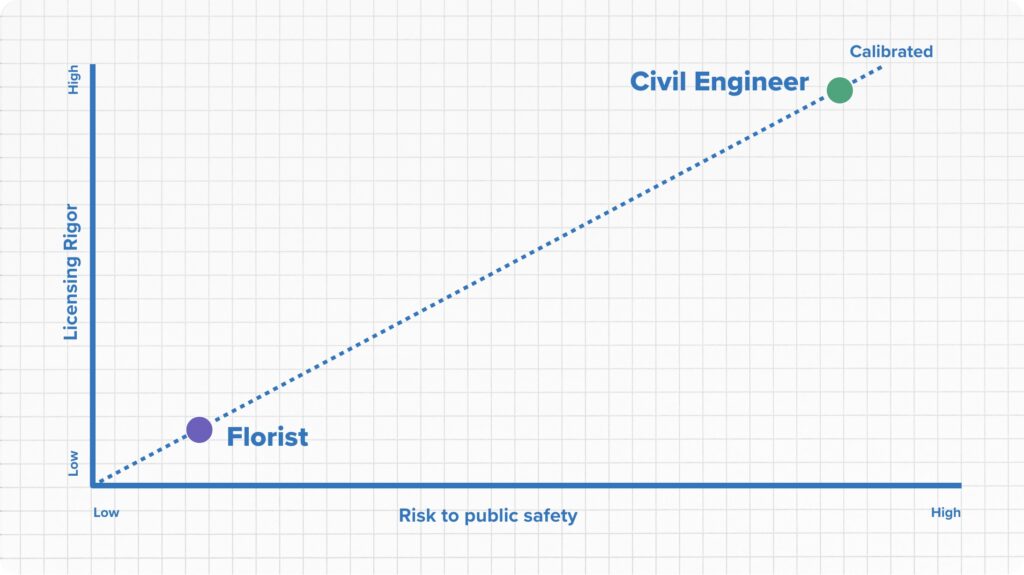
1. THE STANDARD SHOULD FIT THE STAKES
What happens when someone in this field gets it wrong? That’s the right question to ask about any licensing requirement.
If a florist makes a mistake, someone gets the wrong flowers. If a structural engineer makes a mistake, a building fails. The consequences are not equivalent, and the licensing standards should not be equivalent either.
2. EXPERTS SHOULD LEAD LICENSURE
Licensing boards are comprised of experts from the profession because evaluating professional competency in a specialized field requires specialized knowledge. A state legislator or government employee with no background in public accounting is not equipped to judge complex questions of professional conduct in public accounting. The public gets this:
92%
Of Americans say it’s “highly important” for licensing boards to be composed of members with private sector expertise, not state government bureaucrats.
The case for board consolidation often rests on accountability. But these boards are already among the most accountable bodies in state government.

Answer to
the governor

Operate under
state law

Meetings are open and
on the public record

Many include a dedicated public member
What consolidation actually does is replace expert practitioners who understand the work with government staffers who don’t, making the whole system less effective.
3. THE PUBLIC SHOULDN’T PAY FOR IT
Independent licensing boards are one of the few state government functions that pay their own way. The fees professionals pay to maintain their licenses go to the state, which returns them to fund board operations — boards are not reliant on general tax revenue. In reality, the promise to save taxpayers money through “consolidation” — a premise that never made sense, since taxpayers weren’t footing the bill in the first place — ends up costing them more.
What this looks like in practice:
In Georgia, licensing functions previously handled by individual professional boards were transferred to a centralized online system run by a state agency. The new system produced an immediate flood of complaints from businesses unable to obtain or renew licenses. The system designed to save money cost more and delivered less – and the boards with the staff and expertise to do this work were left out of it entirely.
$2M+
Spent to fix the failed system
$10M+
Annual operating budget – exceeded for the first time
Source: 11Alive.com, “Georgia licensing processes change as complaints continue to roll in.” Sep 9, 2025
Legislators who care about fiscal responsibility should ask a simple question: if the current system is self-funded by the professions, and consolidation moves it into the state budget, who picks up the tab? The taxpayer does.
To understand the full scope of the legislative threat: The Issue
For ARPL research, data, and press resources: News & Insights

Here’s what’s at stake, and where we stand.
The Issue
How licensing reform lost its way, and what’s at stake when standards fall
Licensing Threats
Lowering the bar, disrupting the boards, and destroying the system outright
Our Position
What we support, what we oppose, and what responsible policy looks like
News & Insights
Commentary, research, video content, and press resources
About ARPL
Who we are, who we represent, and how to reach us